
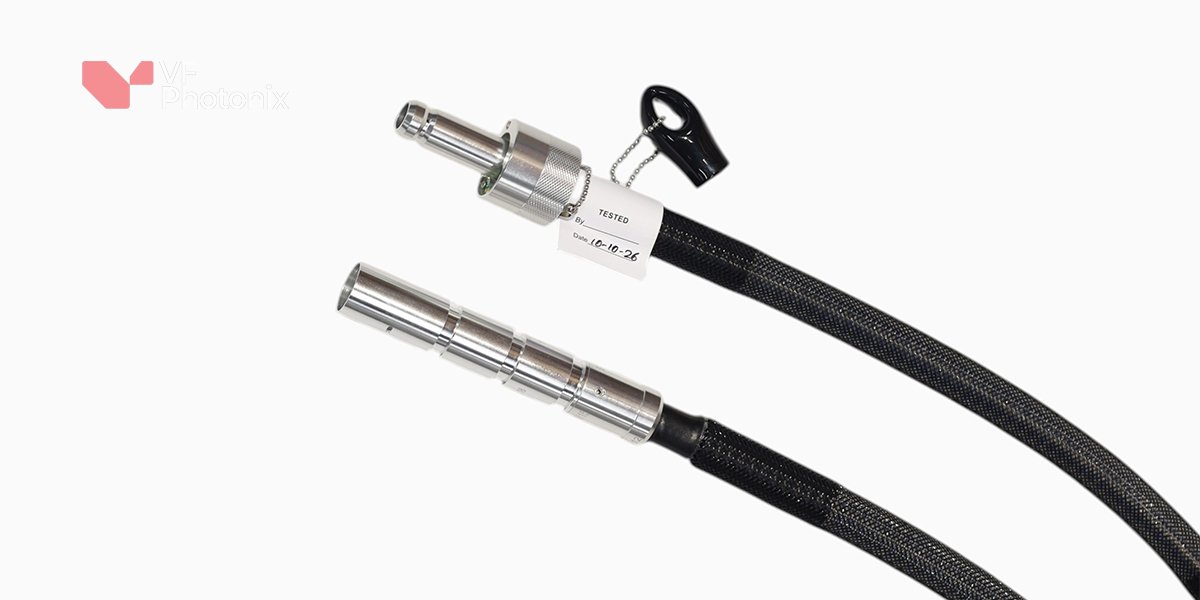
Two optical fiber assemblies can have similar outer jackets and connectors while meeting different purchasing requirements. A quotation that says only “replacement fiber” gives an engineer little to approve and a warehouse little to check when the package arrives.
Optical fiber assembly specifications turn that vague request into a defined item. The buyer does not need to design a fiber or calculate a laser’s operating conditions. The task is to obtain the relevant approved information, preserve it accurately and ask the supplier to identify any differences in the offered assembly.
For distributors and laser service companies, this is especially useful when inquiries pass through several organizations. Each handover can shorten a description. A structured specification sheet helps the final order retain the information that the technical team originally intended.
Define the complete assembly first
Start by identifying the exact equipment model and the fiber assembly’s role in that system. Record the applicable service-part reference and revision where available. Clarify whether you need a finished replacement assembly, a cable with specified terminations or a component for a separately engineered application.
Those descriptions should not be treated as equivalent. A cable specification may describe the fiber itself without identifying all the parts included in a complete equipment assembly. Ask the engineer to define the purchasing boundary before comparing quotations.
VF Photonix’s optical fiber page provides the relevant product connection for an inquiry. A category page is a starting point for discussion; it does not establish the specification or compatibility of an individual assembly.
Confirm the wavelength requirement
Wavelength describes the light involved in the application. Record the required operating wavelength or range from approved equipment information. Do not infer it from the color of a cable jacket, a catalog photograph or the broad name of the treatment platform.
Newport’s fiber optics overview explains that a fiber has a light-guiding core surrounded by cladding. Its optical properties depend on its defined fiber construction. The purchasing implication is to retain the specified optical requirement when requesting the complete assembly.
If the equipment uses more than one wavelength, make that requirement explicit for technical review. Avoid approving an alternative merely because one wavelength appears in its description. Ask whether the supporting documentation covers the full application that your engineer has identified.
Keep core size separate from cable size
The fiber core and the outer cable are different parts of the construction. A jacket diameter or a photograph of a thick cable does not tell purchasing what core specification has been supplied. Use the field names and units from the approved drawing or datasheet.
Record tolerances where they are part of the requirement. A nominal value copied without its tolerance can leave two offers appearing identical when the documented requirements differ. Ask the supplier to flag any proposed variation rather than silently treating it as acceptable.
Where core information is unavailable, mark it as requiring confirmation. Procurement should not estimate it from an image or ask clinic staff to inspect a fiber end. Qualified technical personnel should determine what evidence is necessary through the appropriate documentation and service process.
Include numerical aperture when specified
Numerical aperture, often shortened to NA, describes a fiber’s light acceptance characteristics. Newport explains its relationship to the acceptance angle. For purchasing purposes, the useful question is whether the offered fiber meets the NA requirement stated in the approved specification.
Do not treat a larger number as an automatic improvement. The requirement comes from the system application, not from choosing the highest catalog value. Keep the engineering review focused on suitability for the intended assembly.
An inquiry form can include a field for NA and a separate field for the source document. This prevents an unsupported value from becoming part of the purchasing record. If the supplier proposes a different specification, request a clear explanation and technical approval before changing the order.
Identify both terminations precisely
A connector family name can be useful, but it should not replace the full termination specification. Record the required arrangement at each end of the assembly and attach an approved drawing or reference where available. Clearly distinguish the equipment end from the other termination.
Photographs of externally accessible labels or existing authorized service records can help clarify which end is being discussed. Give each image a descriptive filename. A folder containing several unnamed close-ups can make it harder to determine whether the supplier and engineer are reviewing the same configuration.
Ask what is included with the quoted termination. Covers, adapters, or other associated items should be named if they form part of the purchase. Their presence in a product image does not establish that they are supplied with every order.
Specify assembly length and its definition
State the required length using the convention shown on the applicable drawing. Clarify whether the dimension refers to the cable, the distance between defined reference points or the overall finished assembly. Those descriptions can produce different interpretations if left unstated.
Include the permitted tolerance when it is known. The buyer should preserve that requirement rather than introduce a new tolerance for convenience. Ask the supplier to confirm the basis used in its quotation so the receiving team can compare the correct dimensions.
Length should be agreed with the responsible engineer. Ordering an arbitrarily longer assembly to provide extra reach is a configuration change, not simply an administrative adjustment. Have any proposed variation reviewed before treating it as a substitute for the specified item.
Request applicable handling and storage information
Ask for the instructions relevant to the offered finished assembly. Manufacturer documentation can distinguish parameters such as operating wavelength, construction and permitted bend radius. Thorlabs’ multimode fibre cable documentation illustrates why those fields belong to a particular product, not every fibre cable.
That documentation is a technical example, not a recommendation to substitute a Thorlabs cable into an aesthetic laser. Do not transfer another manufacturer’s values into the VF Photonix enquiry unless your engineer has explicitly specified them for the intended requirement.
For purchasing, agree how assemblies will be identified and protected in a mixed shipment. Request any required handling information before receipt. Warehouse staff should be able to preserve the supplied packaging and distinguish references without making technical judgements about the fibre itself.
Compare offers against one controlled specification
Send the same approved requirement to each supplier. Keep a comparison with a row for each requested field and a place for the supplier’s response. Use clear statuses such as confirmed, different or awaiting clarification. A blank answer should remain an open question.
Compare the supplied condition, assembly contents and documentation as well as the reference. If an alternative is offered, keep it on a separate line until the responsible engineer approves it. Mixing an approved requirement and an unapproved alternative in one description makes later decisions difficult to trace.
Once the order is placed, preserve the accepted revision. If a supplier subsequently proposes a change, request written details and route them through the same approval process. A familiar product name does not make a revised configuration automatically acceptable.
A practical fiber inquiry checklist
- Exact equipment model and applicable revision.
- Approved service-part or assembly reference.
- Finished assembly scope and supplied condition.
- Operating wavelength requirement and its source.
- Core specification and numerical aperture where applicable.
- Complete termination requirements at both ends.
- Length definition and applicable tolerance.
- Required associated items and protective packaging.
- Available product-specific handling documentation.
- Quantity, delivery destination and requested date.
- Named technical reviewer for deviations.
Attach one specification version to the inquiry and label it clearly. If a customer sends a revision later, withdraw the earlier version from the active comparison. This simple record discipline helps distributors avoid quoting different configurations to the same customer without realizing it.
Frequently asked questions
Is the connector type enough to identify a replacement fiber?
No. It is one part of the assembly description. The optical requirements, full terminations, length, and equipment-specific configuration also need review. Ask the responsible engineer which fields and documents are necessary for the particular replacement.
Can a longer fiber be used instead?
Treat a change in length as a proposed variation. Obtain technical review for the intended system and confirm the supplier’s specification before approval. Purchasing should not assume that extra length is harmless or that the original assembly can be modified.
What if the quotation omits core size or NA?
Ask whether those requirements are covered by the quoted approved assembly reference and supporting documentation. If the evidence is incomplete, leave the line open for clarification. Do not add guessed values simply to complete the form.
Can several fiber references share one bulk inquiry?
Yes. Give each reference its own specification, quantity and destination allocation. Keep the individual lines separate even when the request is sent in one document, and require approval for any proposed consolidation or substitution.
Send a defined fiber requirement
At VF Photonix, we welcome inquiries that identify the required assembly clearly. Send your fiber specification and quantities, together with the equipment model, available reference, and delivery country, to request a quotation.
If a field remains unknown, say so. A useful inquiry does not pretend every question is settled; it gives the supplier and your technical reviewer a shared record from which to resolve the remaining details.