
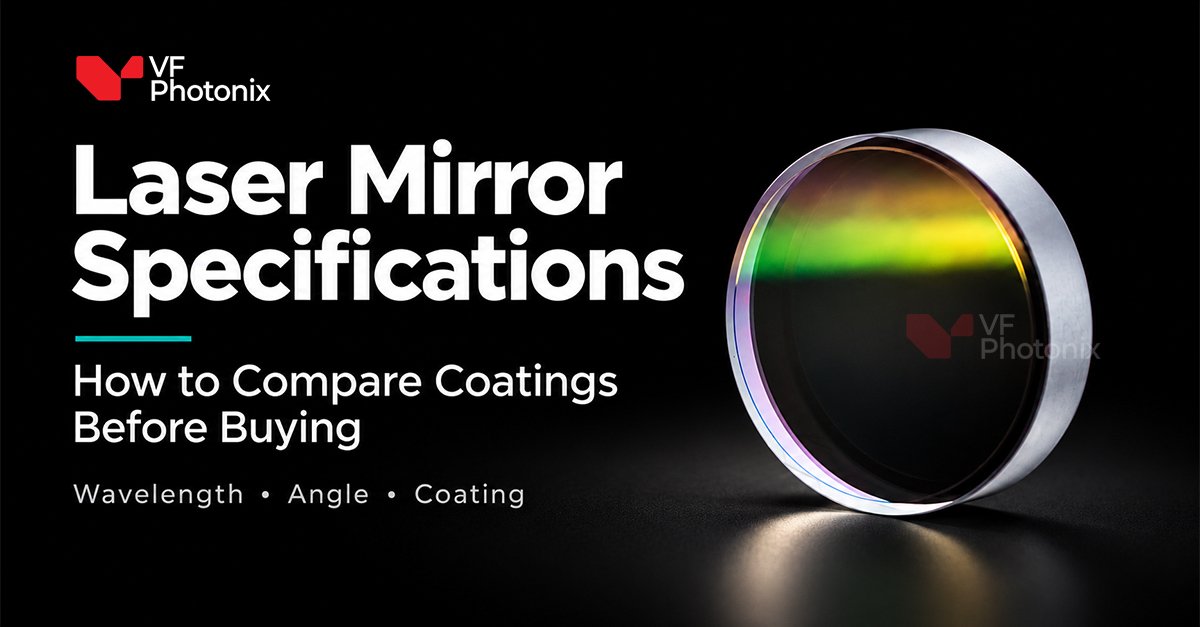
A mirror quotation can look complete while leaving the most important purchasing questions unanswered. It may give a diameter, a product photograph, and a price, but omit the conditions under which the coating is intended to work.
Laser mirror specifications help buyers compare the actual optical requirements. The aim is not to turn procurement managers into optical designers. It is to keep the engineer’s approved requirements intact, identify unanswered questions, and avoid treating similar-looking optics as interchangeable.
For distributors, this matters whenever a customer’s short description must become a supplier inquiry. “Laser mirror” is a product category, not a complete specification. A useful comparison connects the component’s intended function, its approved reference and the documentation behind the offer.
Identify the mirror’s intended function
Begin with the equipment model, applicable component reference, and the role specified by the responsible engineer. Some mirrors are intended to reflect strongly at a particular wavelength; an output coupler has a different defined optical function. Do not select between them on appearance or on a headline reflectivity figure.
VF Photonix’s mirrors and lenses page identifies coated optics, including highly reflective and output coupling types. Those category descriptions help route an inquiry. They do not provide a universal replacement rule for every machine or every mirror position.
If the original purchasing request names only the equipment brand, return it for clarification. Ask for the approved service-part reference, relevant drawing, or engineer-defined specification. Purchasing should preserve that technical instruction rather than infer an optical function from a photograph.
Match the wavelength information
A coating specification should state the wavelength or range to which its performance applies. Record the requirement from the approved documentation and retain any distinctions between individual wavelengths. A figure detached from its wavelength is not a complete basis for comparing offers.
Edmund Optics’ highly reflective coatings guidance presents reflectivity alongside wavelength and other specified conditions. This illustrates why an isolated claim such as “high reflectivity” cannot answer an equipment-specific purchasing question.
Ask suppliers to identify where their quoted performance is documented. If a graph or datasheet covers a broad range, have the engineer confirm that it supports the actual application. Do not assume that a coating sold for one laser family meets every wavelength requirement associated with that family.
Keep angle of incidence in the comparison
Angle of incidence describes the angle at which light meets the surface, conventionally measured from the surface normal. An optical specification can be tied to a particular angle. Preserve the angle identified by the engineer and check that supplier evidence refers to the same condition.
For example, Edmund Optics lists angle of incidence with wavelength, coating and reflectivity on its laser line mirror product specification. The example shows how a manufacturer defines an optic; it does not establish compatibility with equipment serviced by your business.
The purchasing action is straightforward: keep the angle field visible and mark an unanswered response as unresolved. Do not ask someone to change the optical arrangement so a quoted mirror can be used. Any internal assessment or servicing remains the responsibility of qualified personnel.
Ask whether polarisation conditions are relevant
Some coating data distinguishes between polarisation states. Where the approved specification includes that distinction, preserve it in the inquiry and request comparable supplier information. A purchasing summary should not merge separately stated performance requirements into one convenient number.
The responsible engineer should determine whether polarisation is material to the application. A buyer should not infer it from the machine’s marketing description. If the requirement is unclear, ask for an approved specification instead of guessing which catalog column to use.
When comparing responses, record the exact condition attached to each claim. An offer may be well documented but still describe a different requirement. Clear differences should trigger review rather than disappearing into a general comment that the product is “equivalent”.
Distinguish dimensions from optical performance
Diameter, thickness, and shape help define the physical component. Keep relevant tolerances attached to those dimensions. An optic that resembles the original in a photograph still needs to be compared against the approved dimensional and optical requirements.
Keep substrate information and any specified surface requirements in their own fields. Do not compress several drawing notes into “same quality as original”. If a drawing uses an unfamiliar term, ask the technical reviewer to explain its purchasing significance and retain the original specification wording.
For warehouse planning, agree which checks can be completed from labels and documentation and which need qualified technical assessment. Receipt of the correct package description is an administrative check. It does not independently confirm that the optic meets every performance requirement.
Read damage threshold claims with their conditions
Laser-induced damage threshold describes resistance to laser damage under specified test conditions. Manufacturer data may state wavelength, pulse duration, and repetition rate alongside a threshold. Those conditions matter when an engineer decides whether the evidence is relevant to a particular application.
Edmund Optics’ laser line mirror specification provides an example of a threshold accompanied by test parameters. Do not copy that value into another component’s specification or treat it as a rating for VF Photonix products.
Ask for the documentation applicable to the offered optic and have the responsible engineer assess it. Procurement should not rank two products solely by whichever threshold number appears larger. Values quoted under different conditions may not support the comparison the buyer intends to make.
Build a comparison sheet around evidence
Use one controlled requirement for all quotations. Include separate fields for the approved reference, function, wavelength, angle, relevant polarisation conditions, dimensions, substrate and required supporting documents. Add a column for the supplier’s offered reference and a column for unresolved differences.
Keep price comparison separate until the technical scope is clear. A less expensive bare optic and a mounted assembly are different offers. Equally, a well-presented technical sheet does not settle shipping responsibilities, supplied condition or the exact contents of the quotation.
Request a written response to each difference. Accepting a variation should record who approved it, for which equipment, and on what evidence. If a customer is the technical authority, the distributor should obtain that customer’s approval rather than decide on its behalf.
Use a clear approval boundary
Agree who can release the purchase order after the technical comparison. The approver should receive the final offered specification, not an earlier version of the inquiry. Where a drawing or quotation changes, make the revision visible and review the affected fields again.
Preserve the agreed documents with the order. This makes the receiving process more useful and prevents a repeat purchase from relying on a vague product nickname. A new equipment application still needs its own review, even if the reference has been purchased successfully before.
Buyer checklist for coated laser mirror
- Confirm the equipment and exact replacement requirement.
- Record the approved mirror function and reference.
- Retain wavelength and relevant operating-condition fields.
- Include angle of incidence and polarisation requirements where specified.
- Preserve dimensions, tolerances and drawing revisions.
- Request applicable coating and performance documentation.
- Review damage threshold evidence in its stated context.
- Distinguish a bare optic from a mounted assembly.
- Record technical approval of every proposed variation.
- Link the accepted specification to the purchase order.
Use this checklist to structure communication, not to replace the equipment manufacturer’s documentation. Some applications require additional information. Your technical reviewer should determine final acceptance requirements before asking the supplier to commit to a particular configuration.
Frequently asked questions
Can two mirrors with the same diameter be interchanged?
Diameter is only one part of the requirement. Review the coating, optical function, thickness, and other applicable parameters for the intended equipment. Ask for documented compatibility or an approved specification rather than relying on physical resemblance.
Is the highest reflectivity always the best choice?
No. The required optical function determines what is appropriate. For example, assess an output coupler against its specified role. Have the engineer define the requirement before comparing the supplier’s stated performance.
Can a product photograph confirm the coating?
A photograph may help identify the item or its packaging, but it cannot establish the coating’s documented optical performance. Request the offered reference and applicable supporting information, then resolve any mismatch before approval.
What should a distributor do when the customer has no drawing?
Collect equipment details, the approved service reference, and any available records. Explain which information is missing and involve the customer’s technical authority. Do not generate an optical specification from catalog similarities simply to produce a quick quotation.
Request a mirror quotation with a defined scope
Send VF Photonix your optical component requirement, including equipment details, an approved reference or drawing, quantities, and the delivery country. Include the documentation your technical reviewer needs and identify any fields awaiting confirmation.
A useful quotation begins with an agreed description of what is being bought. Keeping optical conditions attached to the specification gives purchasing, engineering and the supplier a shared basis for discussing the offered component.